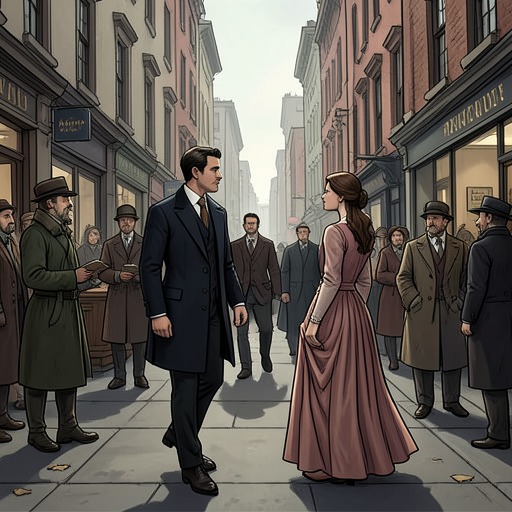
Tattiana Larina
Eugene OneginTattiana Larina is the novel’s inward, imaginative heroine, whose movement from private longing to public self-command gives its love story its most consequential reversal. First introduced as shy and silent, she dreams herself into the heroines of the romances she reads, writes to Eugene, and gradually learns to see him without the romantic veil she had placed over him. Years later, married and recognized as a princess, she acknowledges that she still loves him, yet holds to her promise of fidelity.
Identity and Imaginative Life
Tattiana’s name is presented as an unusual choice for a heroine of a love narrative: the narrator remarks that this is the first time such a name has appeared in one. Her difference is also visible in temperament. She is described as shy and silent, like a timid deer in the forest, and her reserve is not merely a pose adopted in company; it marks her even beneath her parents’ roof. The novel thus introduces her not as the social center of a room but as someone whose inward life exceeds what she readily says aloud.
That inwardness takes shape through reading. Tattiana dreams herself into the heroines of the romances she prefers, with Clarissa, Julia, and Delphine named among them. These books provide her with models and language for imagining love before experience has tested those models. Her romantic imagination is neither incidental decoration nor a settled understanding of Eugene: it is the medium through which desire first becomes legible to her, and the standard against which reality will later force a correction.
Desire, Letter, and Vulnerability
When Tattiana’s thoughts turn toward Eugene, the narrator shows her borne in spirit far away, gazing at the moon before she suddenly speaks. The moonlit moment joins her inward absorption to a movement toward expression: feeling that had been largely private begins to take form in words and action. Her desire does not remain a silent daydream.
The decisive expression is Tattiana’s letter to Eugene. The text identifies the letter as hers and opens it with the urgent declaration, “I write to you! Is more required?” That direct voice gives her longing a clarity absent from her earlier silence. Yet disclosure does not bring security. As the letter’s emotional exposure is followed by the sound of approaching horse-hoofs, Tattiana’s spirits sink, tears fill her eyes, and she shrinks. The scene places the boldness of confession beside the bodily apprehension of its consequences: she has spoken, but cannot control what answer will come.
Recognition and Reversal
Tattiana’s understanding of Eugene changes over time. The novel describes her as beginning, by slow degrees, to understand more clearly what sort of man he is. The gradual phrasing matters: recognition is a process, not an instant repudiation of her earlier love. It marks a passage from reading Eugene through the heroines and expectations that shaped her imagination toward a more discerning view of the person before her.
Later, Eugene has spent a winter in the country as an idle, sad anchorite. By the time their paths cross again, Tattiana has become a young princess and is no longer the shy girl whose feelings first centered on him. Eugene fails to recognize her at first; then the young princess is identified as Tattiana, and the recognition reverses their former positions. He is tortured by regret and falls at her feet. The woman who once exposed her heart to him now stands at the center of a changed social and emotional order, while he is the one who must plead.
Marriage, Love, and Fidelity
In their later conversation, the circumstances of Tattiana’s marriage are made explicit. She has been married for two years, and her husband is identified as a prince. The exchange also establishes that Eugene and the prince have a connection through their neighborhood: the prince says that he and Tattiana live near Eugene, then invites Eugene to come with him. Tattiana’s changed position is therefore not only a matter of inward maturity; she is now a wife and princess within a social world that brings Eugene back into her presence.
At the close of their encounter, Tattiana does not pretend that her former love has vanished. She tells Eugene, “I love you — to what end deceive?” Her candor is paired immediately with a limit: “But I am now another’s bride — / For ever faithful will abide.” Love remains, but it no longer dictates her choice. The decisive contrast is between her first letter, in which private desire crosses into a risky confession, and her final declaration, in which the same desire is acknowledged without being allowed to undo her marriage.
Narrative Significance
Tattiana’s arc gives the novel’s love story a structure of delayed recognition and reversal. At first, she is the reader of romances and the writer of the letter; later, she is the one who understands more clearly, while Eugene arrives too late and falls at her feet. Her growth does not consist in ceasing to feel, but in distinguishing feeling from the action she chooses to take.
The ending preserves both truths at once: Tattiana loves Eugene, and she will remain faithful to her husband. That refusal prevents the reunion from becoming a simple reward for belated passion. Her final agency lies in speaking honestly while holding to a commitment that desire alone cannot cancel, completing the movement from the timid girl’s vulnerable confession to the married woman’s deliberate answer.